



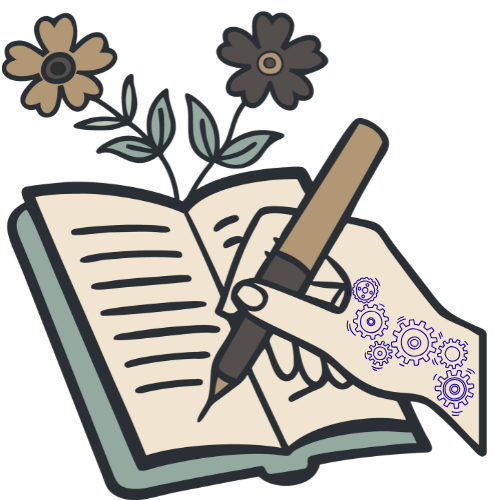
The responsibility of truth no longer lies with identity.
We can now generate images in a manner of seconds. A video of the highest fantasy rendered in realism. Musical chords are separated and rearranged in a perfectly catchy average.
Perhaps most prominent in our adapting world of Artificial Intelligence, however, is the construction of words. Of phrases and ideas that are essentially retrieved from a data set. How could a process so abstract be a numbers game?
Our very best and brightest have ensured that we don’t have to be. They have stolen our fire and fed in to a machine that can perfectly package and summarize. Our Prometheus is rewarded with wealth.
Our world was not always this way, so a question remains. If the idea of AI’s novelty is inherently false, is convenience our utmost priority in writing?
In the collegiate perspective, the growing prevalence of AI in high school paralleled that to university work. Many professors noted that though this became an issue in late 2022, schools often did not have the opportunity to address on an administrative level until 2023. While honor codes are rather strict in this regard, the lack of regulation in corporations has freed many concerns about the exponential use of this technology.
Plagiarism guidelines now have paragraphs upon bylines of AI protection. Writing, however, can only prevail of the individual want of a generation to strive for authenticity. Otherwise, AI is still readily available.
“It’s incredibly easy to mistake the products of AI as novelties, but that’s clearly not true,” Copy Editor of Magazine Loukya Vaka (12) said. “AI models themselves build their answers using datasets created from existing sources, so they’re not as original as we think.”
Within formulaic work, such as resumes and lists, AI is evidently beneficial: it can transform the mundane into efficient groundwork. In this way, AI can trim the fat of the nonessential, and increase organization.
However, it is crucial to comprehend how the effect lack of regulation of this technology could impact our creative fields. Streaming services are investing in AI music companies, animation studios are turning to potential artificial methods. What may go next?
Beyond even the nullification of jobs in an industrial sense, the world’s perspective of prioritization of authenticity and creative integrity in the age of artificial intelligence is critical to observe. Do we seek to value was is real in the fake, or are we dazzled at the intangible?
The value of words is great to me. I hold them preciously to my chest and present them to the world with the knowledge that though wide the range of judgement may be, it is based on my ideas and fabrications of worlds alone.
It can be easy to be caught in the theoretical novelty of AI; its world seems uncharted. However, its landscape is formed from the intellectual geography that we have already formed.
Would Dorothy have dozed so enchantingly with pixelated poppies?
Authors seek not to be the dictator of our words, but to be a cartographer of the geography in our minds.
We often have to seek to communicate in order to refine our intent. As said by English author EM Forster, “How do I know what I think until I see what I say?”
Writing is inherently relational, it excavates the most abstract yet visceral angles of our human experience, and seeks to actualize them so others can view them.
It makes those fleeting, eluding moments tangible. It provides visuals to that which we see but cannot articulate, and rids those unknowing of your ignorance blindness. Writing can be obstructed only by the clarity of the author.
It is through our inflections, our phrasing, our errors, that humanity can be inferred. Any literary stumble is a testament to our relentless pursuit of truth.
Authors undertake the responsibility of the masses, through the voice of one.
The specificity of the perspective on an individual is illuminating in its way to open doors to understanding. In contrast, AI presents a cumulative average of all written experience. It cannot capture the unique condition of the day.
As spoken by American soul artist Nina Simone, “It’s an artist’s duty to reflect the times in which we live.”
How should we expect to reflect our evolving experience if we rely singularly on past conventions?
Writers are already susceptible to the trite, to the cliche. They stand on the shoulders of giants for plot, they quote Mark Twain for his unique twist on the quotidian. They reference “Hope is a Thing With Feathers” for its ability to consolidate lofty optimism with definite imagery.
These great works, however, are meaningful because they impact how we view the world, and likewise, how we describe our shaped application in a changing world.
As long as we continue to document perspective, our legacy is emboldened.
AI is a tool, and can such be wielded, but be cautioned: it cannot substitute for substance. A poor concept will remain a poor concept without introspection and passion. AI can provide neither.
The task of designing our future through recording the present falls on the shoulders of one rhetorical Atlas:
What do you think?

Mr. Schaper | Oct 14, 2025 at 1:18 pm
(fire emoji) (fire emoji) (fire emoji)
Bryan | Oct 16, 2025 at 12:21 pm
(Ditto) (Ditto) (Ditto)