




This Tuesday may have been the first major Election Day in President Donald Trump’s second term, but many firsts were in store for Democrats as well.
Zohran Mamdani, a state lawmaker who was virtually unknown by his now-voters a year ago, was elected New York City’s first Muslim and South Asian mayor.
Mary Sheffield and Abigail Spanberger became the first women elected to be Detroit mayor and Virginia governor, respectively. The first Muslim woman elected to a statewide office became Ghazala Hashmi, now the Virginia lieutenant governor-elect.
The first state to officially oppose Republican-led redistricting became California, whose voters overwhelmingly voted for Proposition 50, a redistricting measure that could help Democrats flip as many as five House seats.
Other victories for the Democratic Party included Mikie Sherrill winning the New Jersey gubernatorial race, Georgia seeing two Democrats win statewide public commissioner seats by large margins and Pennsylvania Democrats retaining three Supreme Court seats. In addition to the governor and lieutenant-governor, Virginia also elected Democratic Jay Jones as attorney general and gained a Democratic majority in the House of Delegates.
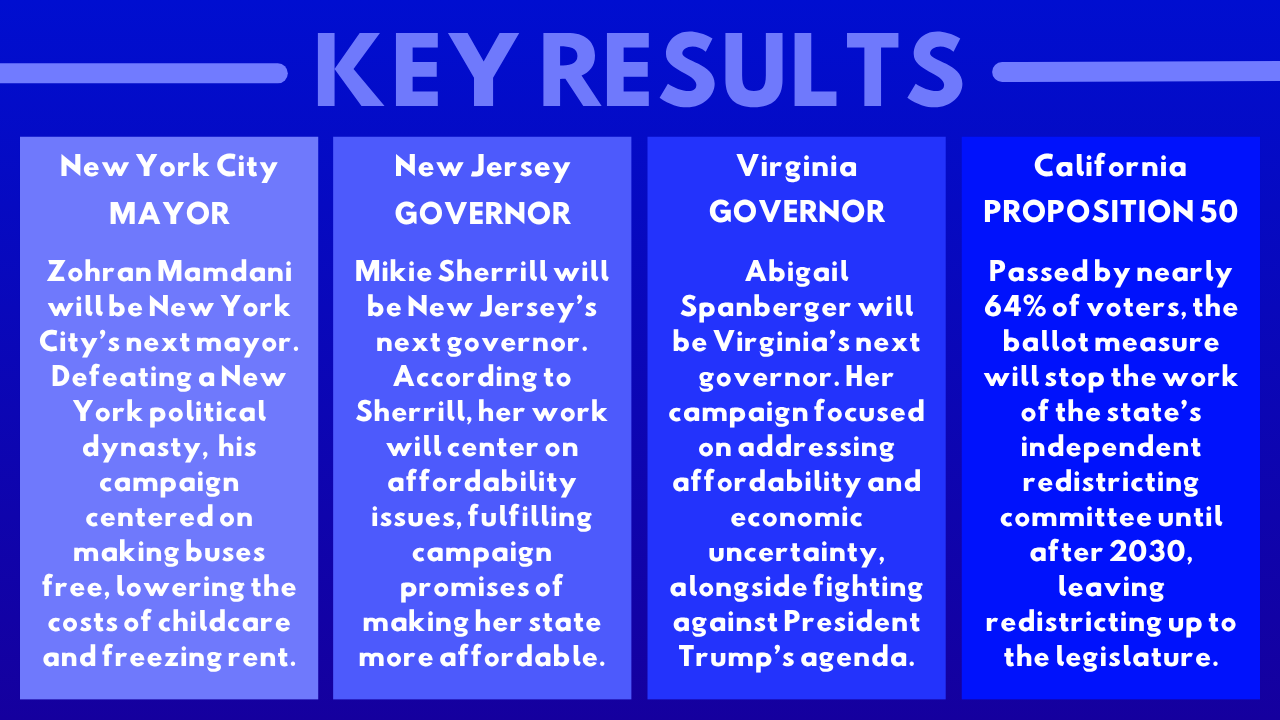
These firsts and historic victories for Democrats are recognized as a referendum, a voter-led reaction, against President Trump. Though the Republican was left off ballots, he remained a looming presence over the conscience of voters as they cast their ballots this Tuesday.
Republican nominee for New Jersey governor, Jack Ciattarelli could not differentiate himself from President Trump, who was behind the cancellation of funds that would benefit New Jersey commuters by way of an ambitious rail tunnel. Though Ciattarelli chose not to embrace President Trump during previous run for New Jersey governor four years ago, he took to verbally supporting the president’s policies regarding border security and the One Big Beautiful Bill Act during his second gubernatorial debate. His race was a decisive win for Sherrill.
“There is a revolt against Trumpism,” Sen. Bernie Sanders told CNN on Wednesday night. “I think Democrats have the momentum.”
Despite several of the winning Democrats fervently associating their opponents with President Trump, with or without his official endorsement, to voters, Republicans have other explanations for these Election Day results.
“I don’t think the loss last night was any reflection about Republicans at all,” House Speaker Mike Johnson said at a Capitol Hill press conference on Wednesday morning. “What happened last night was blue states and blue cities voted blue.”
In a Wednesday dinner with senators, President Trump asserted that the ongoing government shutdown, now the longest shutdown in history at 37 days, was a major factor contributing to the electoral wins for Democrats.
President Trump and his allies within Congress have consistently blamed Democrats for the shutdown, with a government shutdown clock listed on the official White House website stating “Democrats have shut down the government.”
Other factors that President Trump attributes to the results of Tuesday include himself not being on ballots, therefore being unable to draw Republican voters and a lack of celebration for the political wins of Republicans, particularly regarding the economy. Despite long-held opposition from senators of his own party, President Trump also suggested eliminating the filibuster in order to end the government shutdown.
Exit polling data revealed that the economy and cost of living remains a top issue among voters across the nation and in conjunction with Tuesday’s elections, spurred calls for a shift in the focus of the Republican party.
“Our side needs to focus on affordability,” said Vivek Ramaswamy, who ran for the Republican presidential nomination in 2024, via X.
The rise of the Republican Party in the nation’s capital following the inauguration of President Donald Trump forced Democrats and their supporters to display their opposition using alternative methods, including filibustering and filing lawsuits against actions of the current presidential administration. The series of off-year, yet critical elections on Tuesday represented a test for the minority party.
“The Democratic Party is not dead,” said High School Democrats of America Chair Zayed Kadir. “It was never dead, it was solely in a state of transition and we are now seeing the effects of it.”
Celebrations by Democrats across the country do not resolve the tension within the party, especially between its moderate and progressive sectors. Though Mamdani, a democratic socialist, will be inaugurated as New York City mayor in January, incumbent Minneapolis mayor Jacob Frey defeated his socialist challenger Omar Fateh in a rank-choice election called on Wednesday. The Seattle mayoral race between incumbent Bruce Harrell and challenger Katie Wilson, whose campaign has been compared to the Mamdani campaign, is close.
Tuesday was a victory for Democrats nationwide, but where these results will guide the moderate and progressive left as the 2026 midterm elections near remain unclear.
“After 2024, there was such an overwhelming disappointment,” said Kadir. “But, now the party has hope again.”
