


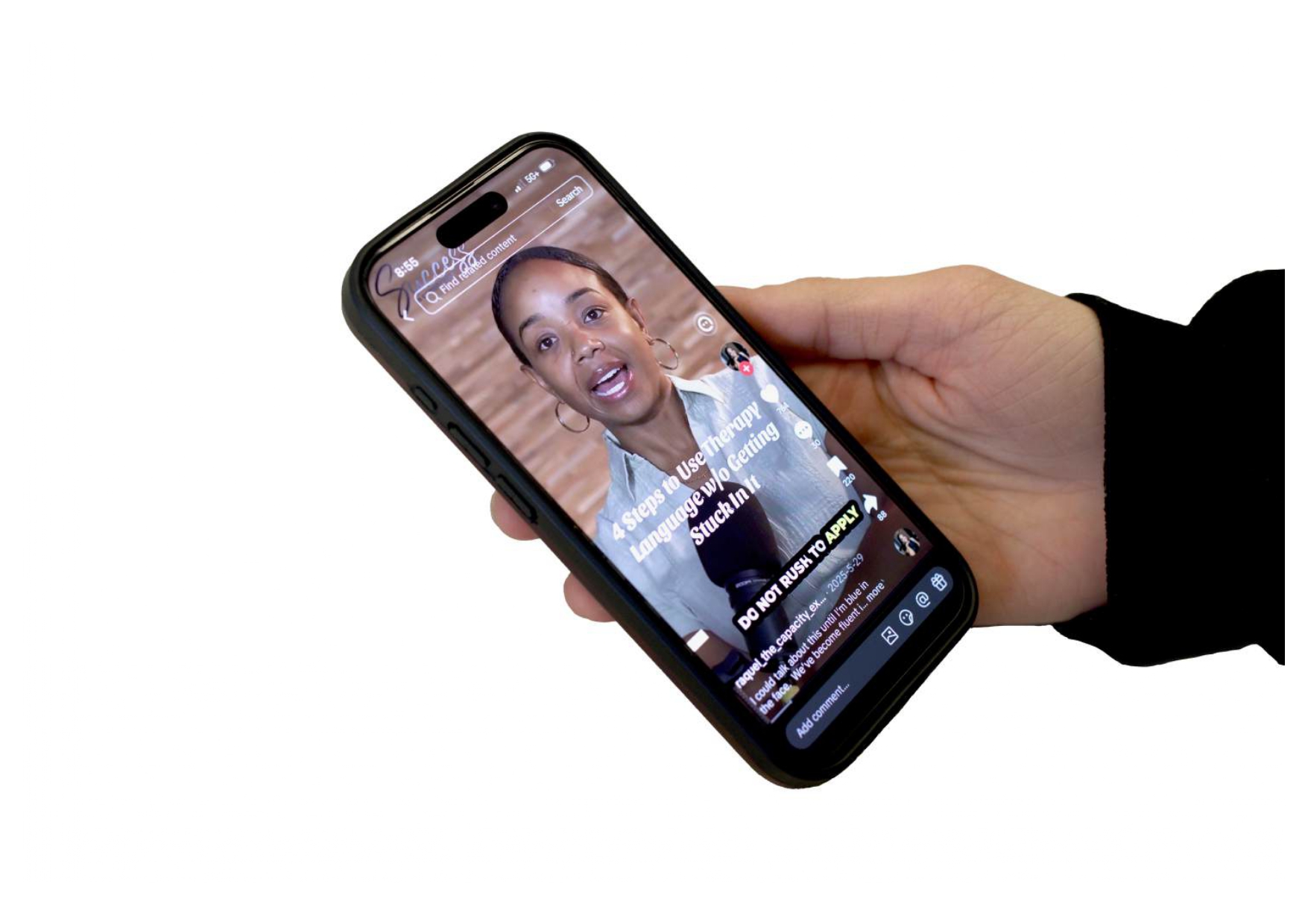

TikTok has exacerbated an already rampant issue: the general public is discounting the severity of mental illness.
While TikTok serves as a great outlet for many, a place to remove themselves from everyday stressors, it frequently sees a specific type of terminology thrown around across posts. As these words appear in more and more videos, the meaning of them begins to turn cloudy. The severity of their implications gets lost.
TherapyTok, an emerging subculture on the app, has reached a vast audience. Many users have found a new source for information on their mental health, validation, and support. 30 second videos explain different attachment styles, signs of toxicity within relationships, and the symptoms of Major Depressive Disorder.
As a result, users self-diagnose, receive unrealistic advice to improve their mental health, and—overall—begin to lack a true understanding of what it means to have mental illness.
Serious health conditions are being oversimplified through “TikTok therapy language.” People begin to use real diagnoses in everyday conversation for experiences that fall short of their true meanings. For instance, it is not uncommon for a user to describe themselves as being “overstimulated.” They may be in a loud place, or in a tightly packed room. But what does it truly mean to be overstimulated?
Overstimulation, often experienced by people with ADHD or Autism Spectrum Disorder, is when an individual’s nervous system receives too many signals from the body. Many people’s brains have a means of blocking out a majority of the signals they receive. They don’t feel the clothes on their skin, don’t hear the faint hum of fluorescent lights, and don’t register the people surrounding them. But for some, their brain is unable to ignore these signals.
This is what it means to be overstimulated. A person’s brain becomes overwhelmed with information, and eventually, shuts down.
Just like the term overstimulation, so many phrases have lost their meaning.
Dissociation is not spacing out, it is when mental functions are removed from an individual’s conscious state. An individual with severe dissociation could live through an entire day and not register any of it.
OCD is not a compulsion to keep your room clean or your desk organized, it is a disorder that causes severe obsessions and repetitive behaviors. Someone suffering with OCD could have recurring thoughts that their hands are dirty, and as a result, wash them excessively, until they are raw.
Gaslighting is not as simple as someone telling an individual they are overreacting, it is a form of psychological manipulation. It takes place gradually. Gaslighters attempt to make another doubt their own memories, perceptions, or reality as a whole.
These words, and so many more, have been reduced to off-hand remarks. When an individual with a true diagnosis describes their experiences, it is no longer regarded with the same severity.
