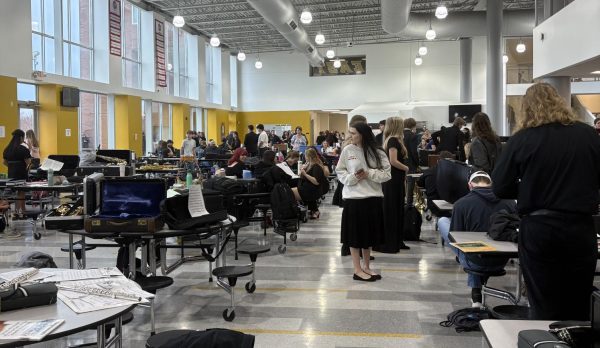


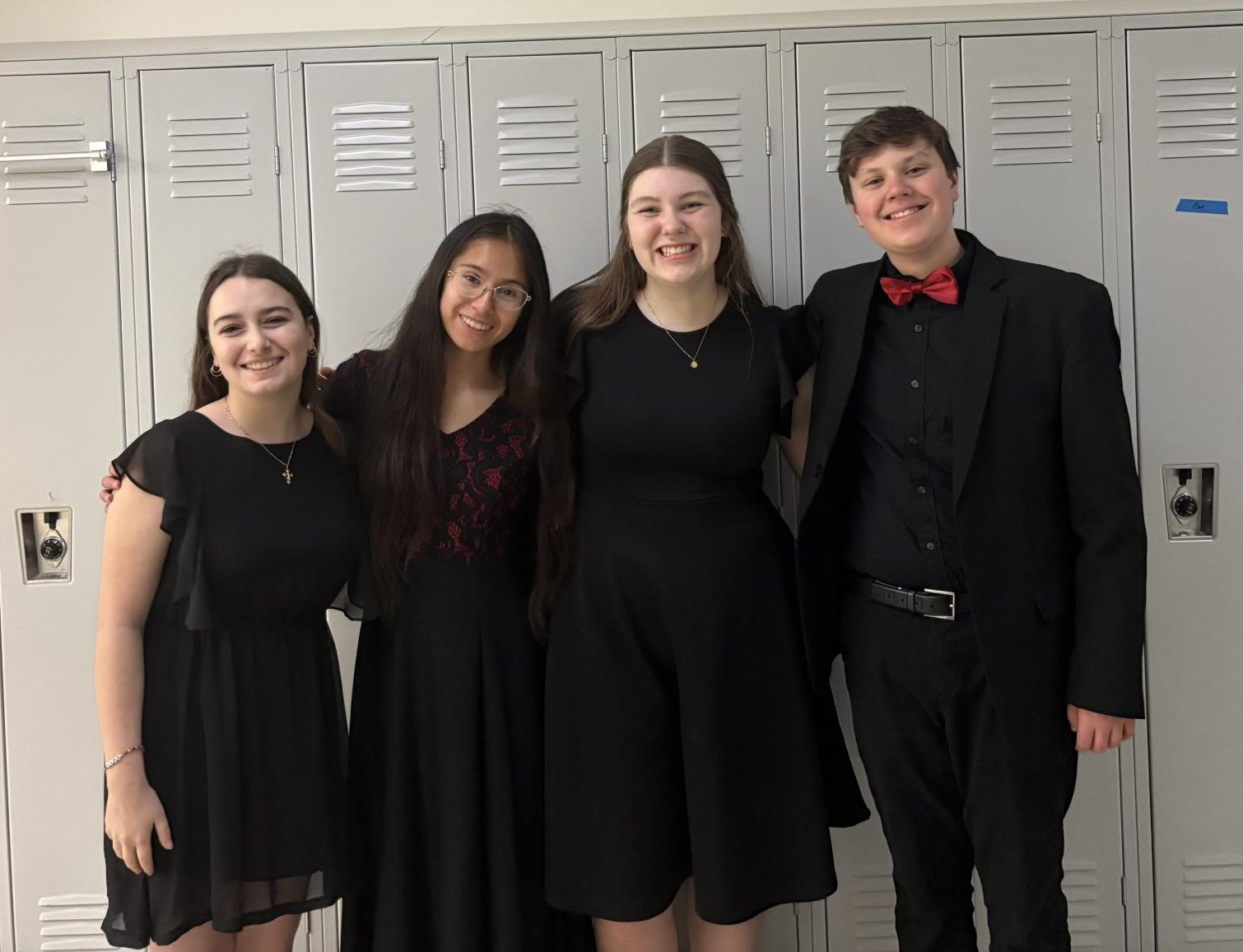
Liberty music students flooded the halls of Fort Zumwalt East for the district solo and small ensemble competition on March 7, each equipped with the armory of beauty.
Voice filled the practice rooms, trumpets enveloped the otherwise mundane cafeteria with tones of sunlight. Snares were beat rhythmically, consistently, echoing the anticipation of noise as the musicians held their breath.
The solo and small ensemble festival is an annual event of which both the choir and band programs participate on the same day. The performers file into bus seats by the silver light of the 7 a.m. sky, each quietly reciting harmonies, fingers peeling over scales on invisible instruments.
Once at the festival, students give up their piece to the judgement of a delegated official, singing or playing their tune by themselves or with a small group, relying on months of preparation to bare a mere few minutes’ emotion. Thus finished, they reverently exit, and await their score.
Each performance is scored on a scale: E (Exemplary), O (Outstanding), S (Satisfactory), and (I) (Needs Improvement). Factors that span across both choir and band in the consideration of scoring include tone, breathing, rhythm accuracy, note accuracy, intonation, style, and dynamics. Those who receive the “Exemplary” rating are eligible to compete at the state level.
This year, Liberty performed in both abundance and quality, showcasing each phenomenal program.
Our band students were awarded 4 Exemplary ratings, 22 Outstanding ratings, and 4 Satisfactory ratings.
The choir received 24 Exemplary ratings and 4 Outstanding ratings.
“It felt amazing to be able to perform at the festival one last time, and the nervousness I felt during the performances was instantly washed away,” Sebastian Tabers (12), who places gold in all of his events, said. “I felt like I did very well in each one, which is something I just love about performing.”
“Accompanying my students is such a joy because I get to collaborate with them in the moment – letting the music rise and fall together and supporting them with sound as they do a very vulnerable thing and sing for an audience. And getting to see their improvement and development throughout the years is incredibly rewarding,” Choir director Carter Datz said, recalling the experience.
The students did not compete against each other, but rather, their own standard of excellence. Each piece of feedback is a dynamic shift, a crescendo into confidence, and a settling into perspective.
Though varied in style, volume, brightness, pitch, octave, length, tempo- each performer’s tool was of a unity that consolidates into a single purpose:
To make music.