



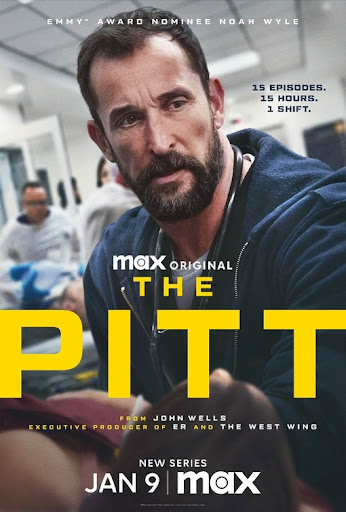
“The Pitt” is a unique medical drama that first aired in January of 2025 on HBO Max. The show follows the nurses and doctors of a Pittsburgh ER through one twelve hour shift, with each episode being one hour of their work day. The show was created in part by long time actor Noah Wyle, who was extremely well known for his role as Dr. John Carter on the hit 90s show “E.R.” Now, he serves as a producer, writer, director and actor on “The Pitt,” where he plays Dr. Michael “Robby” Robinavitch.
In an interview with PBS, Wyle explained “E.R.” and his work’s continued impact on healthcare workers—or those aspiring to be one—inspired him to create a new show that delved into the modern-day struggles of doctors and nurses everywhere.
“I thought maybe there was another story to tell here that’s more contemporary, that reflects what [healthcare workers] are going through now, and that began the conversation that got us where we are here.”
The show is very messaging-heavy and covers some heavy topics surrounding health care workers, mental health, and even current political events. For example, in the most recent season, Wyle’s character was going through a serious and realistic mental health crisis caused by the weight and trauma that comes along with working in healthcare, especially in emergency medicine. In an interview with GQ, Wyle revealed that some of his writing for Robinavitch’s struggles with depression were based on the real-life story of a physician that he’d met, which highlights the show’s commitment to realism and groundedness.
It’s a strategy that has paid off significantly, as “The Pitt” is constantly praised for its accuracy. Recently, there’s been an uptick in shows and movies that feel dumbed down. It was the reason a lot of people didn’t like the later seasons of “Stranger Things”; the writing felt less intelligent and less subtle. This problem stems from something called writing for a second screen. Production companies and studios have had to start making the assumption that most people watching their project are watching while also scrolling on their phone, leading to slow and repetitive dialogue that seems unnecessary at best—and obnoxious at worst—if the audience is actually watching the show or movie.
“The Pitt” doesn’t do this, with a lot of scenes relying heavily on silence and shared looks rather than redundant dialogue. In short, by writing the show in an intelligent way, it makes the audience feel more intelligent, too.
“In a sense, it makes us feel smart. A lot of people joke, especially with The Pitt, that they could now go work a shift at an ER and know exactly what to do. Obviously, that’s not true. But, The Pitt makes us feel like we can,” “Pitt” superfan Mak Barnes (12) said.
Barnes first binged “The Pitt” last spring, and was immediately hooked.
“I was first really investing in the acting side of it all, because I find that stuff really interesting. But the more I learned about the actual production of the show, the more I gained a deep love and respect for it,” Barnes said. “Medical shows are really hard and other TV hospital shows have kinda given the genre a bad rep. But I think The Pitt is shining a new light on that side of TV.”
It’s true that “The Pitt” is a different kind of medical drama. It doesn’t rely on flashy storylines or crazy situations in order to keep the audience entertained or interested. Instead, it focuses on writing dynamic and compelling characters, and letting the show grow from there.
“Nothing truly insane happens on The Pitt, you’re genuinely just following around doctors at an urban ER center. It’s a story that happens every day. But, the characters and their challenges is what makes the show truly what it is,” Barnes explained. “Sometimes, simple is just better.”
A lot of new-age television and movies could learn a thing or two from “The Pitt” and its success. The market is oversaturated with dramas that are only written for shock value, and the more studios continue to churn out the same exhausted storyline in every show, the more it becomes annoyingly clear that these companies are more concerned with quantity than quality. Instead, studios should be focusing on good storytelling and character bundling, which is what not only creates an invested audience, but also builds the story a legacy.
