


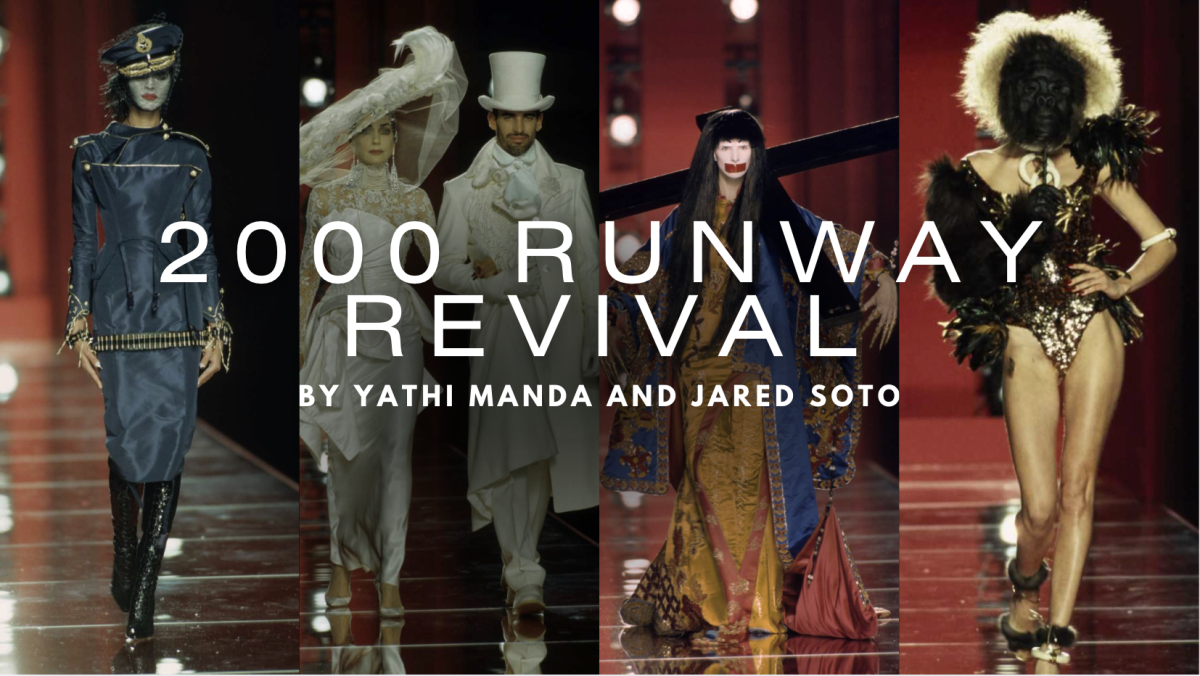
What was high fashion back in the 2000s? Today, we explore the revolutionary haute couture fashion present throughout this period of time, and how it affected the house of fashion today. To talk about revolutionaries we have to talk about pioneers during this time period, such as the infamous John Galliano.
Galliano was more known to others as a key figure and mastermind in the designing world, but was often shamed for his shady and unreasonable presentations. Without his additions to fashion we would not have the courage to break the stereotypical molds of fashion as an art. He is notorious for his work with the House of Dior, more specifically, his Fall/Winter collection that was released in the year 2000, that would live to be known as the most controversial show in fashion history.
The attraction of the runway show itself instantly swarmed attention, featuring just 18 extreme and provocative looks. The show started off illustrating a fairytale love with a priest, bride and groom, and even two children. Though a quick transition brought shocking and more sexual designs, with elements such as the real skull of an alligator, models bound and gagged, and even a 7-foot wooden cross strapped to the back of a model, some looks and elements to the soundtrack of the show caused attendees to storm out. Galliano’s architectural and extravagant designs will always remain in the history of haute couture, regardless of his controversy.
On the subject of transitions in high fashion during the 2000s, modeling definitely faced many. The Y2K era, more specifically 1999-2009 specifically, is a shame to look back on from the present, seeing unhealthy body image and unrealistic beauty standards plastered among every advertisement, major designers, and runway shows such as the Victoria’s Secret annual fashion show.
But as the years went on, and standards became healthier, major modeling agencies started introducing what was the start of the new norm in high fashion modeling. Bolder faces, stronger features, and more alienated looks spread among brands like Chanel, Dior, and honorable mention Paul Poiret. Models weren’t seen to create unrealistic body standards, but rather a body that represented the clothes in a more powerful and modern tone.
The tone that was set also gave way to exotic designs because the faces were unique. Not only was this because of the models themselves, but because of one of the greatest make-up artists of all time, Pat McGrath. McGrath introduced revolutionary styles and techniques of make-up. One of her most notable styles of makeup can be found in her thin eyebrows.
Almost all of her make up looks incorporated this style, best known, on her porcelain doll looks. The look created an uproar on social media, leading to many influencers trying to recreate her look. McGrath’s most notable work was with Dior (FW 2003), Prada, Versace, Dolce and Gabbana, Giorgio Armani, and last but not least Alexander McQueen.
Furthermore, into the topic of McQueen, Futuristic and modern designs appearing more often in the world of haute couture definitely gave way to Alexander McQueen, being a pioneer in the future of impossible fashion and originally working for Maison Margiela, McQueen’s alien-like and extraordinary work made a huge name for him, and even Lady Gaga saying his show “Plato’s Atlantis” was her favorite of all time–if that gives you an idea of the level McQueen was on.
As we face the brunt of the new fashion world, it is crucial to pay homage to these trends that have become legends, celebrities that have become icons.